Friday, April 19, 2013

Review: "Birdemic 2: The Resurrection"


There’s something charming about certain kinds of “bad” movies. For me, I can say that they remind me of my middle school days, when I’d run around the neighborhood, making short films on my palmcorder and S-VHS camera. I cringe whenever I view this old footage - it is just horrible. However, there is an earnestness that comes through clearly; a wanting to make a movie because you love movies, skills be damned.

Birdemic: Shock and Terror was made and put out into the world with the kind of passion that some mainstream directors lack. Through word of mouth, midnight screenings and an excellent Rifftrax commentary, the movie became a cult success. And, like with most successful films, plans for a sequel came out.

Would the same charm that people loved carry over?

Made with a sense of self awareness, Birdemic 2: The Resurrection is exactly the kind of sequel I was expecting. Set in Hollywood - a few years after the events of the original - we almost get the same exact structure: A man and woman fall in love and enjoy great career success along the way. This time, the man is a filmmaker and the woman a struggling actress. Rod (the previous lead) returns, with girlfriend Natalie, to be a financial backer of his friends movie. But, when blood rains from the heavens, birds rise from the tar pits to attack humanity!


Like before, there are no character arcs, no twists, and no real explanation for anything happening. Permission may have been given to shoot in and around better locations and all, but it’s almost the same exact movie. Seriously. The opening, the restaurant scene, the girl getting a gig, the guy getting money, the dancing, the hotel, etc.

Why mess with what worked before, the director must’ve stated.

And if he said that, he’s right. The fans that came out in droves for the original are responsible for the sequel even being made. Knowing what they liked before, director James Nguyen delivers everything with a wink, a smile and a thank you. One line of dialogue in particular, delivered by the boy Rod and Natalie saved in the original, has me convinced of the jokey nature of the production: “I wish my sister were here to see this; she died after eating the fish Rod made.”

Combined with the callbacks and references, this is ultimate fan service. I can’t say that I connected with this the same way I did with the original, but that’s ok. Birdemic 2: The Resurrection is a loving sentiment to a devoted audience. Nguyen may not be good at making movies, but he’s good at showing that he loves movies. A scene where a moviegoing crowd is attacked by birds was shot with real fans in a real theater. I flashbacked to Gremlins 2 at that moment, and remarked to myself how much fun they were all having.

Has the charm returned? Well... it’s more like a twinkle.

All over again, I found myself cringing at the bad line reads and poor edits and shots. But, if I had made this movie as a wide eyed middle schooler, I would be very proud of myself, and look back on that time with fondness. It’s still bad, though.

1/5 *s

Birdemic 2: The Resurrection is coming to NOLA’s Prytania Theatre on April 20th at 10PM, with a special Q&A afterwards. Be there, or download the movie from Chill.com!

Thursday, April 18, 2013

Review: "Oblivion"


I have great affection for David Lynch’s Dune. It’s a movie that barely explains itself, but keeps throwing stuff at you anyways. Sure, The Original Star Wars Trilogy didn’t feel the need to spell everything out either, but it would at least establish and ground things to make the audience comfortable. Dune, on the other hand, expects you to have done some reading beforehand. Despite that problem, I really dig the flick. It’s a classic sci fi adventure with a weirdo modern (at the time) edge. It has a real “you just had to be there to understand” feel to it, and, knowing that I can never go back and “understand”, makes me love it even more.

The latest Tom Cruise movie Oblivion works well as a classic sci fi adventure, but without the special “you had to be there” feel. Actually, it’s really up to you if you want to go at all.

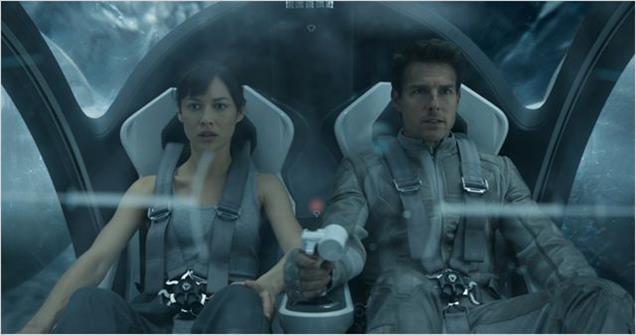
By no means is Oblivion bad; it’s a sleek looking and slickly told tale, constructed in a satisfying and easy to digest manner. At no time did I feel confused or out of place. It’s the kind of movie that makes you slurp an icee with glee and look forward to playing with your Wii when you get home (in fact, the ship Tom uses looks to be controlled by a Wii remote).

I just can’t say that it’s memorable. Is a cult following for this movie possible? Eh.

Tom Cruise plays yet another character named Jack, a technician assigned to maintaining the drones that protect mining machines on what is left of Earth. He must do this while fighting off the occasional Scav, the last of the aliens that invaded the planet years prior. Nearing the end of his mission, an old ship crash lands, revealing a woman Jack knows from his dreams. This leads him to a discovery that will determine the fate of humanity.


After the screening, I remarked to a friend that the story felt like the first in a franchise series, meant perhaps for a trilogy or something. Being a single film just feels off, as there are just lots of interesting things happening that deserve to be explored further. It really should’ve been an hour longer at least (seriously), giving us more to chew on. Morgan Freeman ends up expositing everything in a two minute sequence, clarifying for me that the producers just want you to shovel popcorn in your face while Tom Cruise shoots his gun.

To be fair, that isn’t too bad of a thing, as it actually works here. The visuals are top notch, Tom Cruise is at his most Tom Cruise and the action is fun. As a sci fi movie, it could’ve gone into philosophical territory regarding free will and blissful ignorance vs. knowing the truth, but opts instead for being adventurous on a superficial level. Disappointing, but hey - it works.

Dune, for all of its perceived faults, aimed for being something more than just space drama. It didn’t quite hit the mark, but the ambition was there. Oblivion is more than happy just sticking to what has worked before. It’s like the film equivalent of that guy who spends most of his life just chillin’, playing music and not making waves. Bless his heart, but please don’t follow in his footsteps.

3/5 *s

Wednesday, April 17, 2013

Review: "To the Wonder"


Within my circle of facebook friends, Trash Humpers is one of the most disliked films. Two local theater programmers, while appreciative of Harmony Korine’s body of work, absolutely despise his found footage flick. Every once in a while, the movie will come up in a comment thread, and I’ll try my best to defend it. Well, I’ll defend my view of it, anyways.

Anti-Cinema is what I like to call it. Something that feels more like a statement against what we currently accept as the moviegoing experience. Basically, a movie that is executed and presented in a manner that challenges the audience to a staring contest; some people are up for it, but many will blink and walk away.

“How come the movie isn’t telling me what’s happening?” It is - you’ve just been used to seeing things one way (or in three dimensions).

Enter the Void has a camera that floats around like a wandering spirit, in and out of buildings and memories. Trash Humpers is the movie equivalent of some juveniles lighting things on fire and recording their own exploits. To the Wonder... is love unfolded in a whisper. That might come off as pretentious, but it’s kind of true. Very little dialogue is actually spoken on screen, and when it is, it’s usually under breath. The majority of the narration is in another language and, again, low in volume. Clearly, Terrence Malick doesn’t really want you to concentrate on what the characters are saying.

“So, what is it about?”

An American man falls in love with a European woman, and brings her to the U.S. Over time, their love changes, and they move apart; he into the arms of a woman from his youth, her back to Europe. She comes back, and the two try to recapture that flame.

The early scenes of affection and flirtation are shown with a fluid playfulness, as if the camera wants to capture every bit of the action without being seen by the characters. Later moments of turmoil and conflict are well framed and composed, with the placement of objects, animals, sound, etc telling us what we need to know without saying anything. And really, why speak when you’re so good at showing?

I wasn’t sure about Malick’s religious beliefs before hand, but I now get the impression that he might subscribe to the writings of Jakob Bohme, who suggested that God created life in an effort to understand and justify its own existence. Basically, we are the result of an existential crisis. Throughout the movie, the woman kneels before her man, seeing him as her rock, her source of strength. He says little to nothing (not even in whisper), and seems exhausted and frustrated, not knowing what he really wants. At the same time, there is a local priest - whom towns people look towards for strength and guidance - going through a conflict with his love of God. He feels as if he has been ignored and left alone; much like the woman. Is there real strength to feed off of, when all sources are full of doubt themselves?

In the end, love is shown as being something that can transform individuals and couples; no matter the outcome of a relationship, you have the opportunity to become a better, wiser, and stronger person. We had the strength all along, it turns out.

To the Wonder makes a big statement without saying much. In the current gimmicky atmosphere of moviegoing, stripping a story down to its barest bones is going against the grain. Does Malick go against his own grain? Here he does. The last time was life itself, and now love. What’s up next for the man? I don’t know, but I can bet it will stare into you. Will you blink or stare back?

5/5 *s

Saturday, April 13, 2013

Review: "Where Y'at? (hello.)"

Q) What is Hollywood South?
A) The southern (specifically Gulf of Mexico) region of the U.S., which hosts a good amount of Hollywood film and television productions, because of very attractive tax incentives.

It’s tough out there for up and coming independent filmmakers, especially in New Orleans. Sure, there are tools like social networking and crowd funding that are paramount for artists, but there is no guarantee that any of that will work. And if they do, the benefits aren’t enough to qualify for the same privileges that bigger productions enjoy.

If you’re from Hollywood, they’ll roll out the red carpet. If you’re local, they’ll hire you to be a roller. Despite this, there are people and organizations in the area that are working around the clock to sponsor home grown talent, from festivals and lectures to collaborative projects. Collaborative - what a great word.

TimeCode:NOLA’s Where Y’at? (hello.) is a feature film made up of 15 shorts, each inspired by a city street corner. Think of it as New York, I Love You, but more independent. It’s an excellent introduction to some great talent, filled with DIY spirit and a “look at us!” attitude. Framed around a man eating peanuts on a park bench, telling anecdotes to anybody that’ll listen, the shorts run the gambit from comedic and silly to dramatic and romantic.

Ursulines and Decatur, Directed by Sam Cespedes, might be my favorite of the bunch. It tells the story of a young street musician with a crush on a young street artist. Little is actually said, but what shows through most is the beauty of love from afar and the music you hear when your heart flutters. It ought to be shown at visitor centers to give tourists a taste of the culture.

Another favorite is Dumaine and N. Derbigny, Directed by Corey Fortune. The most abstract and daring short of the movie, it presents a young man’s regret of bad choices (either previous or to come) in a challenging manner. Fragments of a crime, prior to and afterwards, are shown in a fragmented way. This non linear approach makes me feel the lead conflict in a sharp way. And the Garrison Keillor bit was a nice touch, too.

Then, there’s Franklin and Dauphine, Directed by Geoff Douville. A quick documentary on a dispute over a recognizable bar sign, this segment blends a “you have to live here to know” story with pictures and a slightly satirical and mostly fond narration. If you ever see the name Melvin in concrete, just know there is something interesting behind it.

The crew that TimeCode:NOLA brought together proves that not only do we have the people to support our own productions, but the talent to make them shine. If things go well, Hollywood may one day invest in a studio backlot for the area, and conceive of projects WITH us, instead of just outsourcing them TO us.

Q) What do we want Hollywood South to mean?

A) A place where local filmmakers think up, execute and put out movies. A NEW Hollywood.

4/5 *s

Where Y'at? (hello.) will be screening at the New Orleans Old U.S. Mint on Sunday, April 14th, as part of French Quarter Fest. Click here for more information.


Friday, April 12, 2013

Review: "Room 237"


On my DVD shelf sit two movies that I consider among the best I’ve ever seen: Pi and JFK. Both movies deal with lead characters obsessed with their current problems and slowly (but surely) becoming paranoid, seeing conspiracy in everything. Both are less about “the truth” or “the answer” and more about how one can lose oneself in the pursuit of their obsessions. Growing up with OCD, I certainly understand.

Room 237 joins in on the action, except it switches dramatized people and fictional characters for real ones - making what is shown more interesting and (believe it or not) more frustrating to watch. Not really a documentary and not really a “movie”, Room 237 is more like an essay in a style similar to F for Fake. Made up of a series of interviews from film buffs and scholars, we get a frame by frame deconstruction of the messages and meanings behind Stanley Kubrick’s The Shining.

The level of obsession and heightened attention to detail is extraordinary. It reminds of the the early cuts of the 9/11 conspiracy hit Loose Change, or even the lectures by “Truthers” posted on youtube. The smallest and most mundane moments are picked up on and used as evidence of a larger story. The disappearing chair, the window that shouldn’t exist, the light coming out of the plane before hitting the towe...wait - wrong movie.

A zenith of reaching is hit when it is suggested that Kubrick helped fake the moon landing, and used The Shining as his way of telling the public. Yes, the kid where’s an Apollo 11 sweater, and there are some coincidences here and there, but it’s still too vague of a conclusion to come to. It’s very laughable, but only after some groaning.

I suppose these conversations are just a testament to Kubrick’s timeless and universal production, and shouldn’t be seen as anything harmful. Indeed, there is a charm to all of this; the affection people have for art and their joyful obsession for it. But, well, hearing it for over 90 minutes just kinda pisses me off. It’s like going to a party with a friend, separating, and getting into a drawn out discussion with a weirdo stranger. You’ll be thinking “Where’s my ride?” very soon.

It’s not an examination or explanation of film obsession and human psyche, but just an example of its existence. A nature documentary on silly movie buffs? Certainly, the species isn’t going extinct anytime soon. I know these people are around; just go to the IMDB message boards. It’s cool that a movie can be shown as a rubix cube and all, but watching people try to solve a rubix cube isn’t very fun. It’s actually a little depressing, and a bit condescending to the rest of us puzzle solvers.

Not on my DVD shelf is Wag the Dog, another movie I highly recommend. I can remember getting into an argument with my cousin over the image of a briefcase, on a table, under a light. He claimed it represented the fate of Dustin Hoffman’s character, while I stated that it represented a briefcase. I enjoy picking out hidden elements in movies, but I really don’t enjoy making myself sound stupid.

2/5 *s