Within my circle of facebook friends, Trash Humpers is one of the most disliked films. Two local theater programmers, while appreciative of Harmony Korine’s body of work, absolutely despise his found footage flick. Every once in a while, the movie will come up in a comment thread, and I’ll try my best to defend it. Well, I’ll defend my view of it, anyways.

Anti-Cinema is what I like to call it. Something that feels more like a statement against what we currently accept as the moviegoing experience. Basically, a movie that is executed and presented in a manner that challenges the audience to a staring contest; some people are up for it, but many will blink and walk away.
“How come the movie isn’t telling me what’s happening?” It is - you’ve just been used to seeing things one way (or in three dimensions).
Enter the Void has a camera that floats around like a wandering spirit, in and out of buildings and memories. Trash Humpers is the movie equivalent of some juveniles lighting things on fire and recording their own exploits. To the Wonder... is love unfolded in a whisper. That might come off as pretentious, but it’s kind of true. Very little dialogue is actually spoken on screen, and when it is, it’s usually under breath. The majority of the narration is in another language and, again, low in volume. Clearly, Terrence Malick doesn’t really want you to concentrate on what the characters are saying.
“So, what is it about?”
An American man falls in love with a European woman, and brings her to the U.S. Over time, their love changes, and they move apart; he into the arms of a woman from his youth, her back to Europe. She comes back, and the two try to recapture that flame.
The early scenes of affection and flirtation are shown with a fluid playfulness, as if the camera wants to capture every bit of the action without being seen by the characters. Later moments of turmoil and conflict are well framed and composed, with the placement of objects, animals, sound, etc telling us what we need to know without saying anything. And really, why speak when you’re so good at showing?
I wasn’t sure about Malick’s religious beliefs before hand, but I now get the impression that he might subscribe to the writings of Jakob Bohme, who suggested that God created life in an effort to understand and justify its own existence. Basically, we are the result of an existential crisis. Throughout the movie, the woman kneels before her man, seeing him as her rock, her source of strength. He says little to nothing (not even in whisper), and seems exhausted and frustrated, not knowing what he really wants. At the same time, there is a local priest - whom towns people look towards for strength and guidance - going through a conflict with his love of God. He feels as if he has been ignored and left alone; much like the woman. Is there real strength to feed off of, when all sources are full of doubt themselves?
In the end, love is shown as being something that can transform individuals and couples; no matter the outcome of a relationship, you have the opportunity to become a better, wiser, and stronger person. We had the strength all along, it turns out.
To the Wonder makes a big statement without saying much. In the current gimmicky atmosphere of moviegoing, stripping a story down to its barest bones is going against the grain. Does Malick go against his own grain? Here he does. The last time was life itself, and now love. What’s up next for the man? I don’t know, but I can bet it will stare into you. Will you blink or stare back?
5/5 *s

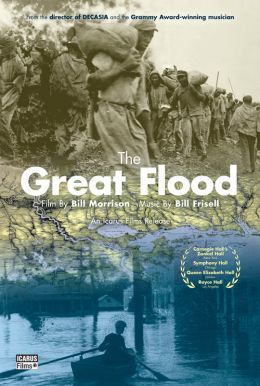 As I sat in a theater filled with mostly middle aged festival goers, halfway through The Great Flood, I came to some conclusions:

