Showing posts with label 3D. Show all posts

Sunday, January 19, 2014

Review: "Life Itself"

In his review of the 3D re-release of Titanic, film critic Roger Ebert wrote:
"James Cameron's film is not perfect. It has some flaws, but I hate the way film critics employ that word "flaw," as if they are jewelers with loupes screwed into their eye sockets, performing a valuation."
This is a line that I not only agree with wholeheartedly, but something I have taken as advice when criticizing
a movie. In college, a good friend of mine would often ask me to define what art is, and if it can be confined to just a few mediums. The answer lies in the mind of the beholder - anything can be considered art, from brick laying to murder (my college friend suggested that last one). To expand further, an art form should not and cannot be confined to a strict standard. Sure, there are basics in storytelling and expression through film, but they can be creatively manipulated and re-imagined in all sorts of ways. Basically, movies are not to be examined as one would a diamond. A movie can be more than one thing.

Roger Ebert spent his career as a film critic observing and picking apart cinema, explaining why and how, from his point of view, what kind of thing or things a particular movie was. His body of work was elegant, evocative and accessible, enlightening many a reader. This I knew. What I didn't know was that Roger was initially assigned to be a film critic. Fate?

In Life Itself, the documentary on Ebert's life and times (which premiered at Sundance just prior to the writing of this review), we learn that the most well known film critic in America is, like the movies he loves and hates, more than just one thing. It's silly thinking such a thing; that it's a surprise to discover a famous person was about more than what we knew them for. That they are people after all. Why keep that wall up between reality and fiction? In between a few hospital stays near the end of his life, the movie unfolds almost from Roger's mind, as if during rehab and doctor visits, he is going over memories painstakingly, to try and make sense of it all. Much like in a film about a biographer visiting their elderly subject. Almost beat for beat, it follows this pattern. To not only have a biopic made ABOUT you, but to also STAR as you, I can only imagine ONE question you might ask yourself; was it a life WORTH TELLING?

We get the fullest scope of the man as possible. From being a barfly to being a grandfather, from losing the ability to speak to strengthening the ability to communicate. Two moments showcased gave, for me, the clearest picture of all.

In the first one, we are witness to an extended reel of footage. It's of Roger and Gene Siskel, recording promos for their groundbreaking television show. In it, they spew more passive aggressiveness and verbally claw into one another more than I thought was possible. Throughout their partnership, Gene would often push Roger's buttons. There indeed was truth to their on screen dual persona of opposites. On TV, they'd argue back and forth on a movie's merits, and would continue debating once the cameras stopped. To order lunch, a coin toss would have to be conducted.

In the second moment, it's another extended reel of footage of the two men recording TV promos. This time, they are joyfully playing with one another, throwing good natured barbs back and forth, and sharing many a smile. At the end, something unexpected happened - it's revealed to be part of the same antagonistic promo shoot. In what was probably considered just mundane b roll to the television crew, Roger's personality and humanity are exposed. I get the strong sense of learning and growth from his relationship with Gene, one that I and many others can relate to. Like Roger, I've treated people both unfairly and friendly, and wished to have done things better. 20/20 perspective never comes during, but after. Damn.

I just read that Chaz Ebert, Roger's wife, spoke after the Sundance premiere. She said that he would often say a good movie leaves an audience member as a much truer person. I agree absolutely with that. The advice on using the word "flaw" when reviewing a movie still stands, and really can be applied to, well, life itself. Hopefully, I'll learn exactly how to apply that one day. It's true.

5/5 *s

If you enjoyed this review, as well as my others on this blog and across the internet, please visit patreon.com/criticalno and consider supporting my work.

Wednesday, May 15, 2013

Review: "The Great Gatsby"


There are many great scenes in Django Unchained, but one in particular stands out for me. After ordering his dogs to tear apart a runaway slave, Calvin Candie stares up at Django, who is on his horse. The two men look into each others eyes, all the while a man is being viciously killed out of frame. They discuss Django’s friend Schultz for a moment, then head on their way to the plantation.

That moment was a cinematic equivalent of a two man poker game. For not even a minute, we learn more about the danger our protagonists face, just how dastardly our antagonist is and more importantly the presence of a power struggle, all without saying much. I love it when what’s unsaid speaks louder than what’s being said.

Imagine that sequence with voice over narration, perhaps from an older Django; does it make you angry?

Now, I don’t want to suggest that the use of a narrator is always a bad move - Sunset Boulevarddid it rather well and Sin City used it verbatim for the source - but I do want to state that it can become your worst nightmare if not used carefully. Have you ever heard the phrase “beats you over the head”? Voice over work can do that to an audience, treating us like we’re undereducated neanderthals. And that’s exactly how I felt when watching Baz Luhrmann’s The Great Gatsby.

I never read F. Scott Fitzgerald’s famous novel. In fact, all I know about it I learned from wikipedia and Rodney Dangerfield in Back to School. From what I gather, the classic tale - about the enigmatic rich man Jay Gatsby, his obsessive love for a married woman from his past and his romantic optimism for a life with her - is, more or less, about the excess, carelessness and emptiness of the 1920’s (which, of course, was followed by The Great Depression). It’s supposed to be a book of rich storytelling and wonderful depth.

If all I knew about this story I learned from the movie it’s based on, I would assume it was about, well, how “Great” Gatsby was. That’s all. Did Tommy Wiseau write up the adaptation?

In Baz Luhrmann’s 3D film, we are presented with what could’ve been the best possible portrayal of the decadent 1920’s ever. Champagne in every hand, glitter and fireworks in the air and jazz playing all the time. Visuals and sounds just bursting off the screen and popping right in your face. There's even a wonderful scene where rich white people dance awkwardly to Jay Z like music in a small apartment. That alone expressed the discomforting and shallowness I was looking for.

But, I’m afraid that was it. It appears as if Mr. Luhrmann didn’t know how to tell this story without directly using the narration from the book. Was he scared of backlash from fans? If so, he shouldn’t have let that control his direction. There are scenes (dialogue, non 3D ones) that could’ve been told in a more subtle and tense manner. Like the one in the Plaza. Our leads are in a room, sweltering from the heat, trying to have fun with some booze. Gatsby wants Daisy to tell her husband that she’ll be leaving him. What could’ve been an incredibly awkward, uncomfortable and intense moment is undercut by Tobey Maguire (Nick Carraway) telling us what’s happening. Something along the lines of “The tension was high. I could see the anger in Gatsby’s eyes. Daisy just wanted to leave.” Yes, thank you. If you hadn’t told us exactly how to feel and think, we just would’ve sat in our seats wondering why the floor is sticky.

I understand that the movie follows the narration of the book pretty closely, but I stress that my problem is not with the author, but with this director. Instead of interpreting the page, and judging how to present it for another medium, he just takes some glue, squeezes it around, and drops glitter on it. There. A book... with glitter. Perhaps he got lost in the spectacle, and forgot what it was all trying to say. Ironically, much like Gatsby's lavish parties, the 3D and confetti didn't bring Baz any closer to the green light he so desired.  

And the framing device doesn’t help. For the movie, it was decided that it would be told by Nick from a sanitarium, while he’s writing it all in a novel. At the end of the movie, he changes the title of his work from “Gatsby” to “The Great Gatsby”. A movie that punches you with an undercut from a fist made of ham. Wow. Peter Greenway has often said that the cinema has become impoverished because of our value of text over image. Baz Luhrmann can sure make colors pop, can't he?

It’s almost embarrassing to say, but this movie might just represent where we are as moviegoers, or at least where Hollywood thinks we are. The fact that a recent Michael Bay movie is told in a less insulting way than an adaptation of an American classic is a travesty.

We’ll always have Tarantino, right?


1/5 *s (though, 2/5 wouldn't feel wrong)

Friday, July 13, 2012

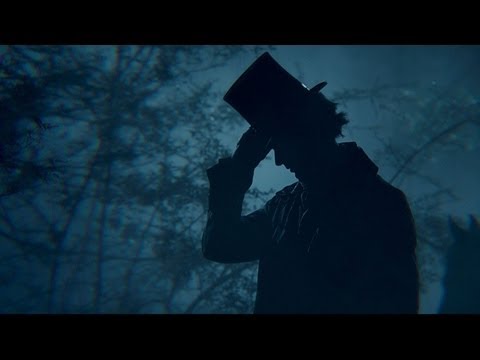
He Said, I Said Review: "Abraham Lincoln: Vampire Hunter"

Part of my blog's new design and new domain name is also a new commitment to posting more content on a weekly, then perhaps daily, basis. To do this, I have to come up with new things to write about, and in interesting ways.

In June, I finally got to meet the Times Picayune film critic Mike Scott during the recording of the first #TeamNOLAFilm podcast. He's a real cool guy, with his own take on movies. A few weeks ago, he posted a fairly negative review of "Abraham Lincoln: Vampire Hunter" - a movie which I actually kinda enjoyed.

The following review will be the first in a series called 'He Said, I Said', where I take quotes from another criticism, and offer a counter (or similar) opinion. Yes, this does mean that I will be somewhat defending a story about an axe wielding, vampire killing American President. Enjoy:
This is a movie that re-imagines our 16th president as a secret, ax-wielding slayer of bloodsuckers. It isn't meant to be a documentary. It's not intended to be scholarly... Rather, it's meant to be bloody, butt-kicking fun, as the Great Emancipator becomes the Great Decapitator.
I couldn't agree more. AL:VH is supposed to be historical revisionism at its most fun. And, with a title so ridiculous, it HAS to deliver on what it advertises. Much like "Snakes on a Plane" before it, this film is, indeed, about what its title says - Abraham Lincoln killing vampires. Nuff said.
But here's the thing about movies rooted in such a fantastical premise as this one: While it's OK for a filmmaker to ask that we suspend our disbelief, that filmmaker has to help us do it. In "Abraham Lincoln: Vampire Hunter," Bekmambetov doesn't come even close to keeping up his end of the bargain.
 Could you give an example?
In a later scene, a particularly nasty vampire -- being pursued by Walker's Lincoln, who has been hell-bent on ridding the world of bloodsuckers since his mother was killed by one when he was but a boy -- throws a horse at the future president. Lincoln catches it. And then rides it.
Thanks. Well, yes, that sequence was pretty hard to swallow. To be fair, the color, lighting and cg made it hard to tell what was going on in the first place... Lincoln showing agile super powers outside of swinging an axe was definitely a misstep, but not that big of one. In the grand scheme of this movie, it was more of a nitpicky oversight; like the use of parsecs in "Star Wars: A New Hope" (though, AL:VH is no SW). My disbelief - and keep in mind that I too can be easily annoyed - was suspended from the opening titles. All notions of reality were thrown out a moving car.

That said (or written), there are some problems with the film, like the pace. Abe learns to kill with an axe in ONE SCENE! He swings, hits a tree a few times, and is able to destroy it moments later. In "Kill Bill Volume 2", when The Bride is training to punch a hole through a block of wood. We see her struggling to accomplish this over an extended montage, before finally doing it in the present time. Lincoln gets maybe a minute before he heads out for the hunt. Let us see his training! Let us get to know him better! We go from angry young man to idealist to President in no time.
Another casualty, and an unforgivable one, is the central metaphor from the Seth Grahame-Smith book on which it's based, in which Lincoln's fight against the parasitism of vampires is equated with his fight against the parasitism of slavery...
...those who had read the book knew that - aside from the whole vampire-hunting thing - it was a surprisingly well-researched Lincoln biography. You could revel in the guilty-pleasure aspect of it, but you could also learn a thing or two about our 16th president. That added a satisfying weight to Grahame-Smith's yarn. For Bekmambetov -- who co-wrote the screenplay with Grahame-Smith -- all that goes out the window.
This is the second main problem. We do get historical figures in cameo wink wink appearances, and, with the revisionist tone, major events in Lincolns life are closely tied to vampires (like the death of his son). But, for me at least, a certain amount of weight was missing. For example, the civil war battles. We see Union soldiers violently stabbing Confederates and vampires (one even gets a knife crowned on the top of his head) with Lincoln giving a speech in a voice over. This made me chuckle, when it shouldn't have. The schlocky nature of the story suddenly turned against itself.
Ridiculous is OK -- but this is beyond ridiculous. Rather, it is a schlocky, poorly made, B-movie mess.
Beyond ridiculous is just as good, if not better at times. Problems acknowledged, this still works as a fun goof of a film. Just be sure you at least use wikipedia in your essay on the Civil War.

3/5 *'s

Feel free to offer suggestions and comments regarding this new series.